Using M5StickC to Set a Radio-Controlled Clock Where JJY Reception Is Unavailable
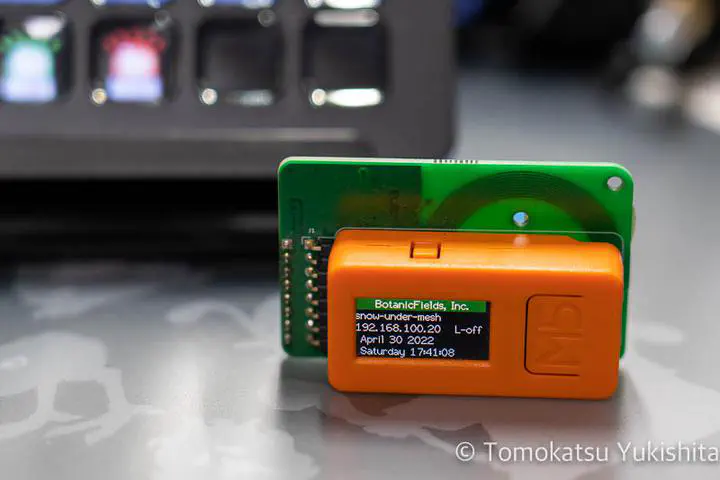 Image credit: Tomokatsu Yukishita
Introduction
Radio-controlled clocks are convenient because you do not need to set the time manually. I also use one at home.
After Moving, the Clock Stopped Receiving JJY
Radio-controlled clocks are only convenient when they can actually receive the standard radio signal. After I moved, mine stopped receiving JJY, and the displayed time gradually became inaccurate. It could still receive the signal near a window, but carrying it there every time was obviously not practical.
How Can I Bring the Signal Indoors?
I wanted a more convenient way to keep the clock synchronized, so I started looking into possible solutions. It turns out there are dedicated products that retransmit time signals for radio-controlled clocks.
Commercial Retransmitters
Here are some of the products I came across:
- Kyohritsu Electric AC-synchronized time transmitter P18-NTPAC
- Uses household AC frequency to maintain time.
- Can transmit a time signal to a radio-controlled clock within about 10 meters.
- KEISEEDS GPS time repeater P18-NTPGR
- Uses GPS time data rather than an internet connection.
- Clock with radio-controlled clock signal transmission function P18-NTPLR
- Retrieves time from SNTP over the network and retransmits it.
All of them were fairly expensive. Accurate timekeeping is nice, but I felt it was hard to justify the cost for home use.
Could I Build Something Similar Myself?
That led me to think: maybe I could create a simpler substitute with a bit of DIY work. I checked Switch Science, a store I often use for electronics parts, and found exactly the kind of thing I was looking for.
- Switch Science
- JJY antenna board for M5StickC
- JJY antenna board for M5Atom Lite/Matrix
- M5StickC
- ATOM Lite
- ATOM Matrix
Even if I bought both the antenna board and the M5 device, the total cost was still under JPY 5,000. That was cheap enough to make it worth trying immediately. At the time I bought it, only the M5StickC version was available, so I purchased the M5StickC and the antenna board.
Build It as Soon as It Arrives
Once the parts arrived, I started assembling it right away.
I was able to flash the device without any trouble by following the materials linked from the Switch Science page.
- Project page (GitHub)
- JJY simulator program (GitHub)
- Qiita article about generating a JJY-like signal with M5StickC / M5Atom
Testing It
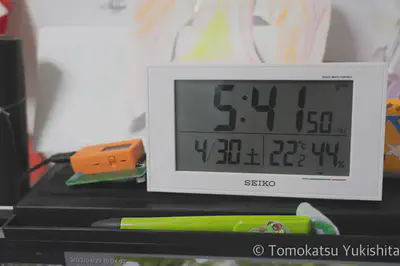
After flashing the program, all I had to do was place it next to the radio-controlled clock and wait for reception. The signal is weak, so it only works at close range.
Remaining Issue
If I use it near a microwave oven, the Wi-Fi connection drops and does not reconnect automatically. It has to be restarted manually.
Summary
With a relatively small investment, I was able to build a practical way to synchronize a radio-controlled clock even where normal JJY reception is poor.

Tomokatsu Yukishita (雪下 智且)
Engineering Manager / Real Estate Transaction Agent
Engineering manager connecting embedded development with cloud and AI. I apply quality standards from mission-critical systems to modern product and development workflows.